
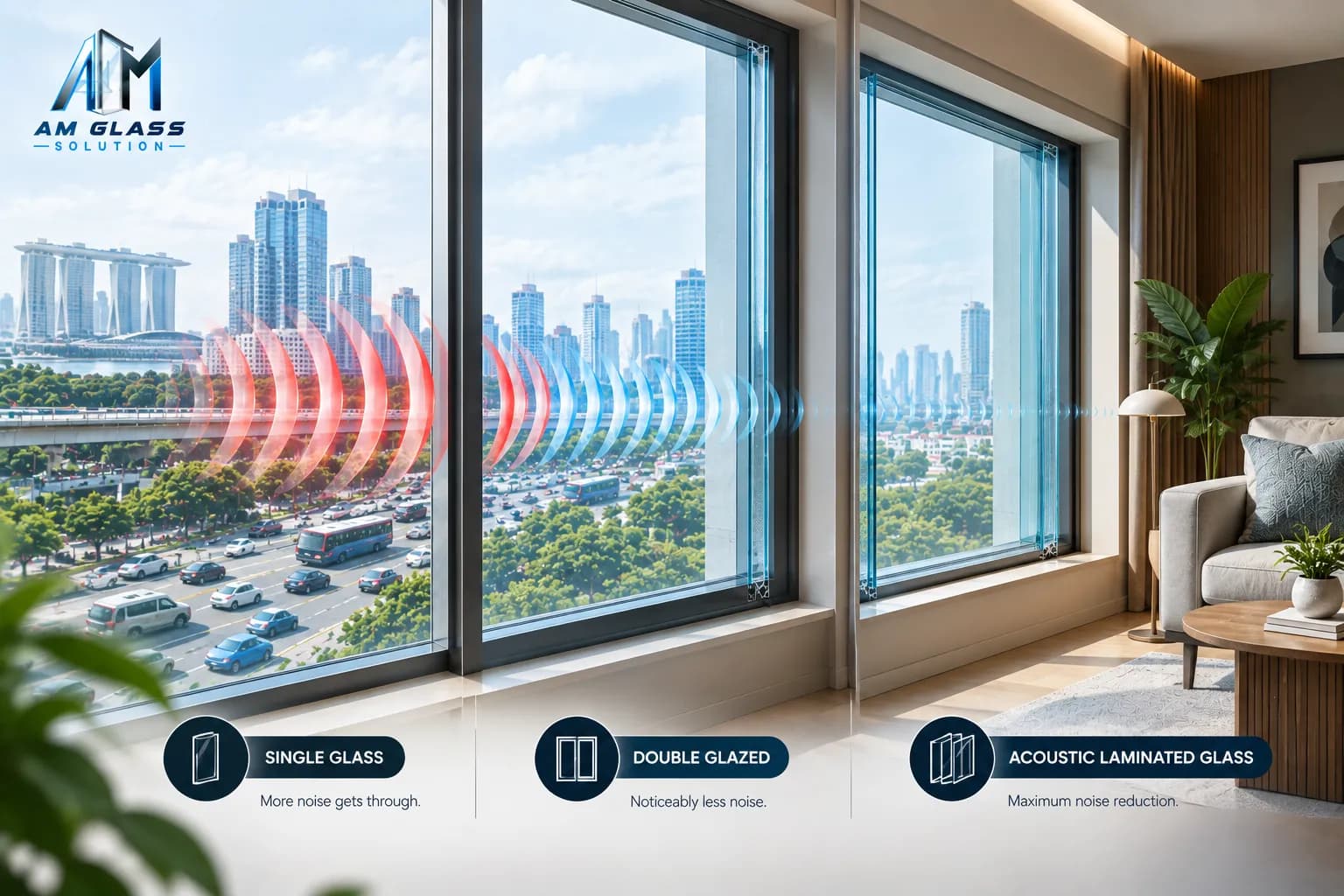
How Much Noise Can Soundproof Windows Reduce in Singapore?
If traffic, construction, MRT sounds or activity outside your property are making a room uncomfortable, upgrading the windows can be one of the areas worth investigating.
But there is an important question homeowners and businesses often ask:
How much noise can soundproof windows actually reduce?
The honest answer is that there is no single number that applies to every window or every building.
A window's acoustic performance depends on the glass, frame, seals, installation, opening style and the type of noise outside. A window designed for a busy road may also require a different approach from one intended to improve privacy between office meeting rooms.
For Singapore properties, this distinction matters because outdoor noise can come from many different sources, including traffic, construction activity, public transport and neighbouring activity.
WHAT DOES "SOUNDPROOF WINDOW" ACTUALLY MEAN?
The term "soundproof window" is commonly used to describe windows designed to reduce sound transmission.
It does not necessarily mean that the room will become completely silent.
In architectural acoustics, sound insulation is normally discussed using measured performance rather than promising that all outside sound will disappear. For example, STC is one rating system used to compare how well building elements reduce airborne sound, although it has limitations and does not represent every type of noise equally. Wikipedia
That is why a responsible quotation should focus on the actual window configuration and the noise problem rather than simply promising a percentage reduction.
HOW MUCH NOISE REDUCTION CAN YOU EXPECT?
There is no universal "soundproof window = X dB reduction" figure.
Two windows that look similar can perform differently because of their glass composition, frame, seals and installation.
The same window can also produce different results in different buildings.
For example, imagine two bedrooms:
Bedroom A faces a busy road.
Bedroom B faces an internal corridor.
Bedroom C is beside an office meeting room.
The type and frequency of sound are different in each situation. The suitable glazing system may therefore be different as well.
This is why the complete window system matters more than a single glass specification.
WHAT AFFECTS NOISE REDUCTION FROM A WINDOW?
Several parts of the installation can influence the result.
Glass type
The glass is one of the most important components.
Laminated glass contains multiple glass layers bonded with an interlayer. The interlayer can provide additional sound insulation compared with monolithic glass of the same thickness. Wikipedia
Acoustic laminated glass is therefore often considered when external noise is an important concern.
Glass thickness and configuration
Simply choosing thicker glass is not always the complete answer.
Different glass thicknesses and combinations can behave differently across sound frequencies. For a property affected by traffic or other outdoor noise, the appropriate configuration should be selected according to the actual application.
Double glazing
Double-glazed windows have two panes separated by a space.
This additional separation can improve sound insulation when the unit is properly designed and sealed. However, standard double glazing should not automatically be described as a high-performance acoustic window.
The glass composition, cavity, frame and seals all contribute to the final result.
Window seals
A small gap around a window can undermine the acoustic performance of the glazing.
Sound can find its way through openings around the frame, joints or seals. This is one reason why proper sealing is just as important as choosing the glass.
Singapore's NEA also highlights the importance of sealing gaps and joints when discussing effective noise-control measures for construction barriers. While this guidance concerns construction sites rather than residential windows, the underlying principle of preventing sound leakage is relevant when thinking about acoustic systems. National Environment Agency
Frame and window design
A good acoustic glass panel installed into a poorly performing frame may not deliver the expected result.
The frame, opening mechanism, joints and sealing should therefore be considered as one system.
Installation quality
Even a carefully selected window can underperform if it is not fitted correctly.
Poor alignment, gaps around the frame or inadequate sealing can create pathways for sound.
This is why measuring the existing opening and understanding the condition of the current window should come before choosing a replacement.
WHAT TYPE OF GLASS IS SUITABLE FOR NOISE REDUCTION?
For many noise-related projects, laminated acoustic glass is one of the options worth considering.
Laminated glass uses an interlayer between glass layers. Besides its safety properties, the interlayer can contribute to sound attenuation. Wikipedia
For more demanding applications, a laminated acoustic glass configuration can be combined with other glazing and framing approaches.
The important thing is not to assume that one product works for every situation.
A home beside a busy road, an office meeting room and a restaurant partition all have different acoustic requirements.
SOUNDPROOF GLASS PARTITIONS FOR OFFICES
Noise reduction is not only a residential window issue.
Singapore offices often use glass partitions because they allow natural light to move through the workplace while dividing meeting rooms, private offices and working areas.
The challenge is that ordinary glass partitions may not provide the level of acoustic separation required for private conversations.
A soundproof glass partition in Singapore can be designed using acoustic laminated glass, suitable framing and appropriate sealing to improve sound separation while retaining the visual openness of glass.
AM Glass Solution provides soundproof glass partitions and doors for offices, meeting rooms, studios, homes and commercial spaces in Singapore. Its service page describes acoustic laminated glass, single- and double-glazed options, acoustic seals and customized partition systems. amglasssolution.com
This is particularly relevant for:
Meeting rooms
Private offices
Conference rooms
Music or recording spaces
Restaurants and cafés
Commercial interiors
Residential spaces requiring better separation
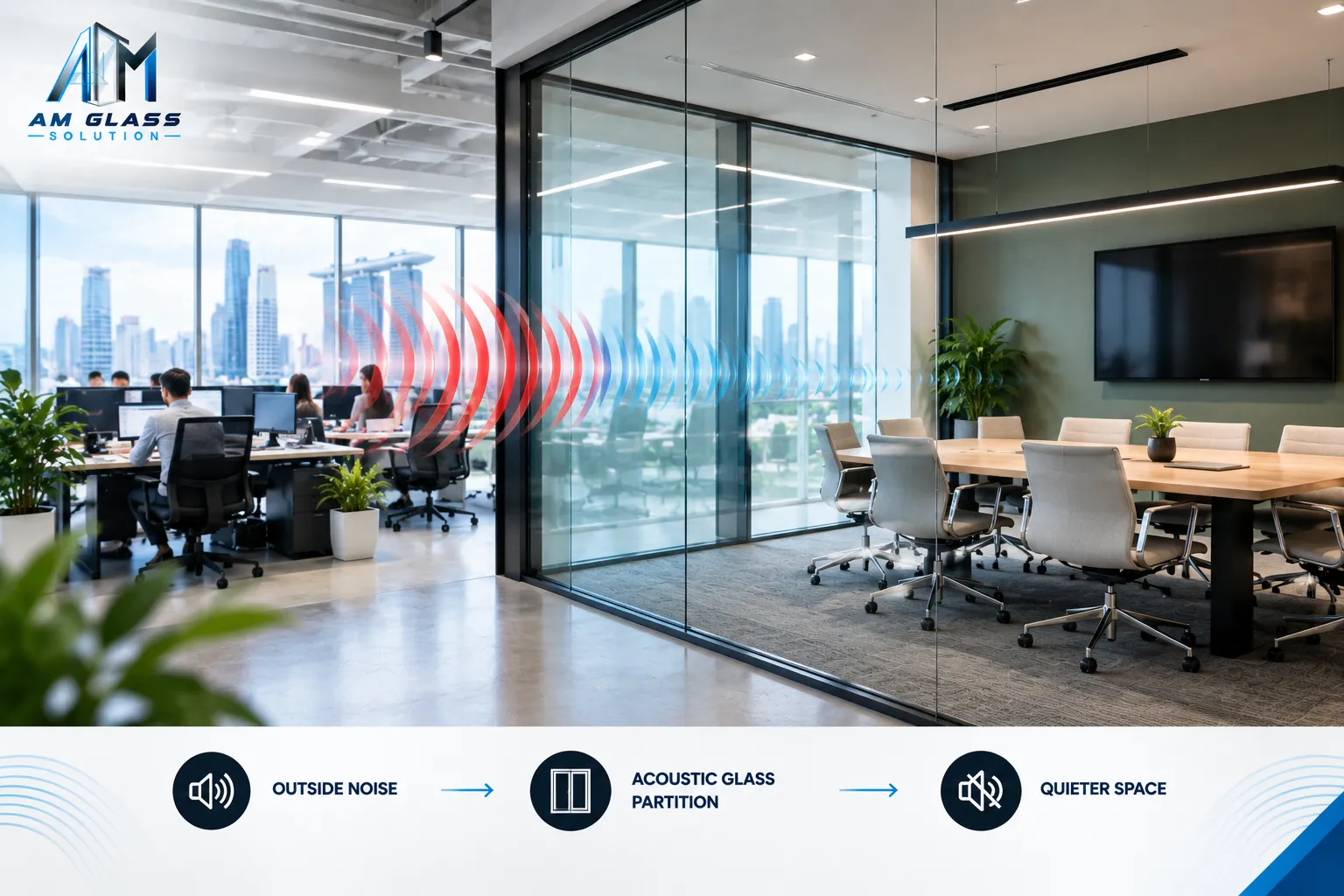
HOW MUCH CAN A SOUNDPROOF GLASS PARTITION REDUCE NOISE?
Again, it depends on the complete system.
AM Glass Solution's current service page advertises acoustic glass solutions with stated STC ranges for some of its partition applications. However, those figures should be treated as system-specific specifications, not as a guaranteed noise reduction percentage for every project. amglasssolution.com
This distinction is important.
An STC rating is not the same thing as saying:
"Your room will be 45 dB quieter."
STC is a laboratory-based rating used to compare sound transmission performance, and real-world results can be affected by surrounding construction, doors, frames, gaps and other sound paths. Wikipedia
So when comparing quotations, ask for the performance specification of the complete system rather than focusing only on the thickness of the glass.
WHAT ABOUT TRAFFIC NOISE IN SINGAPORE?
Traffic noise is one of the more challenging problems because it can include a wide range of frequencies.
Cars, buses, motorcycles and heavy vehicles do not all produce the same sound characteristics.
If your home faces a busy road, an acoustic window assessment should consider:
Existing glass
Window frame
Seals and gaps
Window opening style
Glass thickness and configuration
Whether double glazing is appropriate
Installation conditions
Other possible sound paths
The goal is not simply to install "more glass."
The goal is to identify the weakest part of the existing window system and improve the overall acoustic barrier.
WHAT ABOUT MRT AND CONSTRUCTION NOISE?
Singapore's built environment means some homes and offices are located close to construction sites, roads and public transport infrastructure.
Construction noise is regulated by the National Environment Agency (NEA), which sets permissible noise limits for construction work and applies different limits according to time periods and the type of affected premises. National Environment Agency
However, regulatory limits and window performance are two different things.
A construction site complying with its applicable noise requirements does not mean the noise will be inaudible inside a nearby property.
If construction noise is affecting your room, the window should be assessed as part of the building envelope rather than assuming that replacing the glass alone will solve everything.
CAN SOUNDPROOF WINDOWS BLOCK ALL OUTSIDE NOISE?
No.
This is one of the most important things to understand before investing in acoustic glazing.
A window can reduce sound transmission, sometimes substantially, but complete silence is not a realistic promise for a normal residential or commercial window system.
Sound may still enter through:
Walls
Doors
Ceiling or floor structures
Ventilation openings
Other windows
Gaps around frames
Building structure
For this reason, the right question is usually:
"Where is the main sound path, and what can be improved?"
rather than:
"Which glass blocks 100% of the noise?"
SHOULD YOU CHOOSE ACOUSTIC GLASS OR DOUBLE GLAZING?
It depends on the project.
Acoustic laminated glass uses an interlayer to improve sound attenuation.
Double glazing uses two panes separated by a cavity.
These approaches are not necessarily mutually exclusive. A project can be designed around a combination of glazing, spacing, laminated glass, framing and sealing.
Wikipedia's overview of soundproofing also notes that well-sealed double-pane windows can provide greater sound insulation than single-pane windows, while laminated acoustic glass can be useful where transportation noise is a concern. Wikipedia
The practical comparison should therefore be between complete window systems rather than simply "laminated versus double glazed."
HOW CAN YOU TELL IF YOUR EXISTING WINDOWS ARE THE PROBLEM?
Before replacing your windows, look for obvious signs that the existing installation may be allowing sound through.
For example:
You can feel air movement around the closed window.
There are visible gaps around the frame.
Seals look worn or damaged.
The window does not close tightly.
Outside noise becomes noticeably louder near the window.
The existing glass is very thin or basic.
The frame has deteriorated.
The window is difficult to close or align properly.
These signs do not prove that the window is the only source of noise, but they can indicate that an assessment is worthwhile.
HDB HOMEOWNERS: CHECK THE WINDOW REQUIREMENTS
If you live in an HDB flat and are considering replacing your windows, acoustic performance is not the only consideration.
HDB states that installation or replacement of windows in HDB flats must be carried out by a BCA Approved Window Contractor listed in HDB's directory. HDB also states that a renovation permit is required for window replacement work. Housing & Development Board
This means homeowners should check the applicable HDB requirements before arranging window replacement.
For HDB properties, acoustic improvement should be planned together with safety and renovation requirements, rather than treated as a standalone glass upgrade.
WHAT SHOULD YOU ASK A GLASS CONTRACTOR?
Before accepting a quotation for soundproof windows or partitions, ask a few practical questions.
What type of noise is the system designed to address?
What glass configuration is being proposed?
Is the glass laminated, double glazed or a combination?
What frame and sealing system will be used?
Is the quoted acoustic rating for the glass or the complete system?
Will the existing frame be retained?
If the existing frame is retained, has its condition been checked?
Are there other possible sound paths in the room?
Is the proposed installation suitable for the property?
For HDB work, does the contractor meet the applicable window requirements?
These questions can help you compare solutions based on performance rather than marketing terminology.
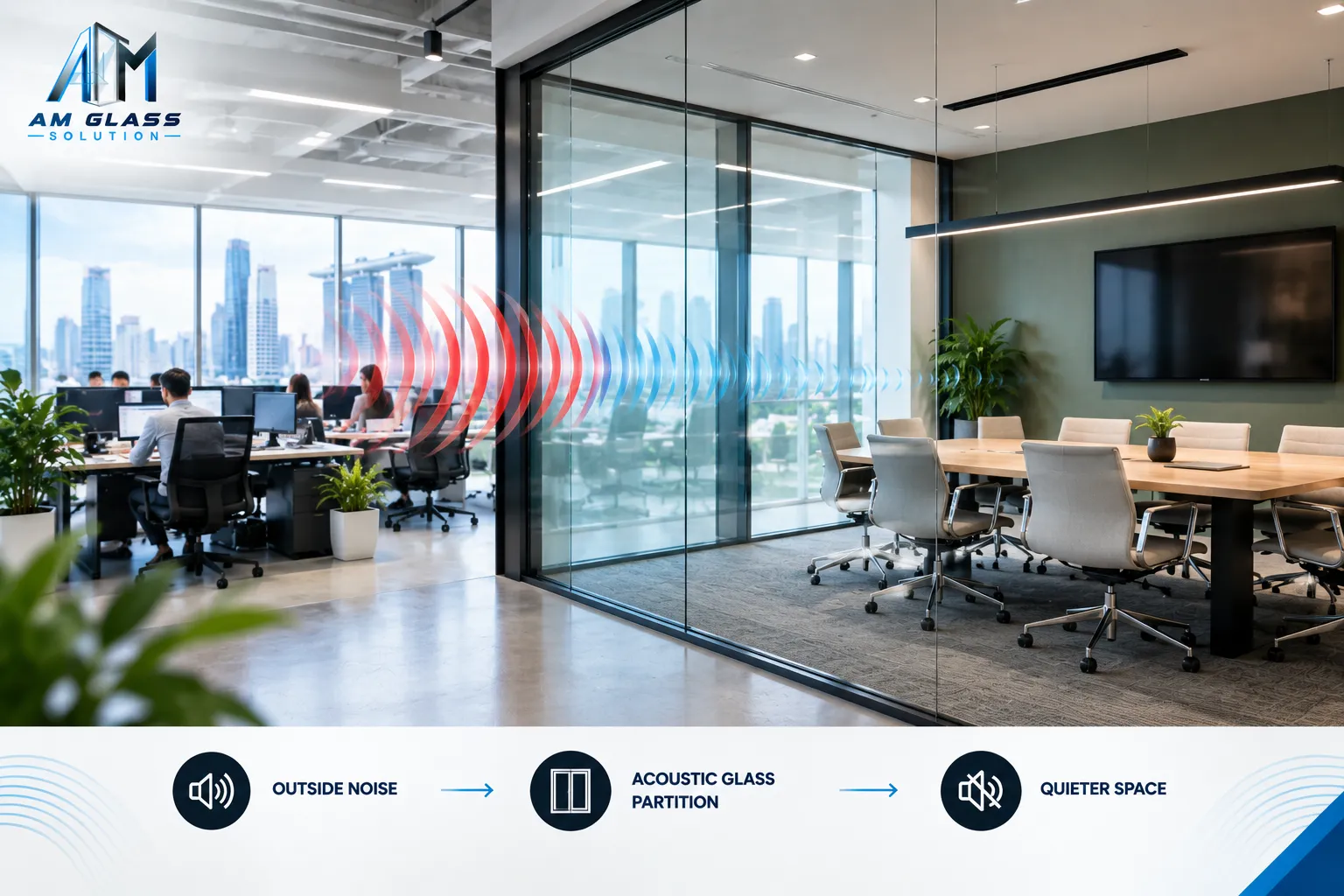
HOW AM GLASS SOLUTION APPROACHES SOUNDPROOF GLASS
AM Glass Solution provides soundproof glass doors and partitions in Singapore for residential and commercial applications.
Its service offering includes acoustic laminated glass, acoustic seals, single- and double-glazed configurations, office partitions, meeting-room glass walls, HDB-related acoustic window solutions and other customized glass systems. amglasssolution.com
For a noise-related project, the useful starting point is not simply choosing the thickest glass.
It is understanding the existing installation, identifying the noise source and selecting a glass, frame and sealing configuration that suits the space.
FINAL ANSWER: HOW MUCH NOISE CAN SOUNDPROOF WINDOWS REDUCE?
There is no honest single percentage that applies to every soundproof window in Singapore.
The actual improvement depends on the glass, frame, seals, installation, building construction and type of noise.
Acoustic laminated glass can improve sound insulation, while double glazing and properly sealed window systems can also contribute to better acoustic performance. In some projects, combining these approaches may make sense.
For offices, a properly designed soundproof glass partition in Singapore can help separate meeting rooms and work areas without giving up the visual openness of glass.
For homes, particularly those exposed to traffic or other persistent outdoor noise, the best approach is to assess the existing window before deciding whether to upgrade the glass, improve the seals or replace the complete window system.
The objective is not to promise silence.
It is to create a window or partition system that is properly matched to the noise problem.
For soundproof glass doors and partitions in Singapore, you can explore AM Glass Solution's service page and discuss the requirements of your space.
External references used in this article: Singapore's NEA construction noise guidance, HDB's window-work requirements, and Wikipedia's technical overview of laminated glass. National Environment Agency
Tags: soundproof glass partition Singapore, soundproof windows Singapore, acoustic glass Singapore, noise reduction windows Singapore, acoustic glass partition, soundproof glass doors, laminated acoustic glass, office soundproofing