Best Privacy Solution for Existing Glass Office in Singapore
If your Singapore office already has glass meeting rooms, partitions or glass doors but lacks privacy, retrofitting PDLC smart film is one of the most practical solutions to consider.
Unlike permanent frosted film or blinds, smart film can allow the existing glass to switch between a clearer state and a private frosted state when required. This makes it particularly suitable for meeting rooms, director offices, consultation rooms and other spaces where privacy changes throughout the day. Current Singapore suppliers position smart film specifically as a retrofit solution for compatible existing glass.
The important point, however, is that not every existing glass panel is automatically suitable for smart film. The glass condition, dimensions, installation environment, electrical routing and required privacy level should be assessed before choosing a solution.
Why Existing Office Glass Creates a Privacy Problem
Glass partitions help offices feel larger, brighter and more connected. But the same transparency can become a problem when a room is being used for:
Confidential meetings
Management discussions
Interviews
Client consultations
HR discussions
Financial discussions
Healthcare consultations
Sensitive presentations
Traditional solutions such as curtains, blinds or permanent frosting can solve the visibility problem, but they can also change the appearance and functionality of the space.
The better question is therefore not simply:
“How do I make my office glass private?”
It is:
“How can I keep my office open and transparent when privacy is unnecessary, but make the glass private immediately when confidentiality is required?”
That is where switchable privacy technology becomes particularly useful.
What Is the Best Privacy Solution for Existing Office Glass?
For suitable existing glass, PDLC smart film is usually the first solution worth assessing when you want switchable privacy without replacing the glass.
PDLC stands for Polymer Dispersed Liquid Crystal. The film is applied to the existing glass and connected to an electrical control system.
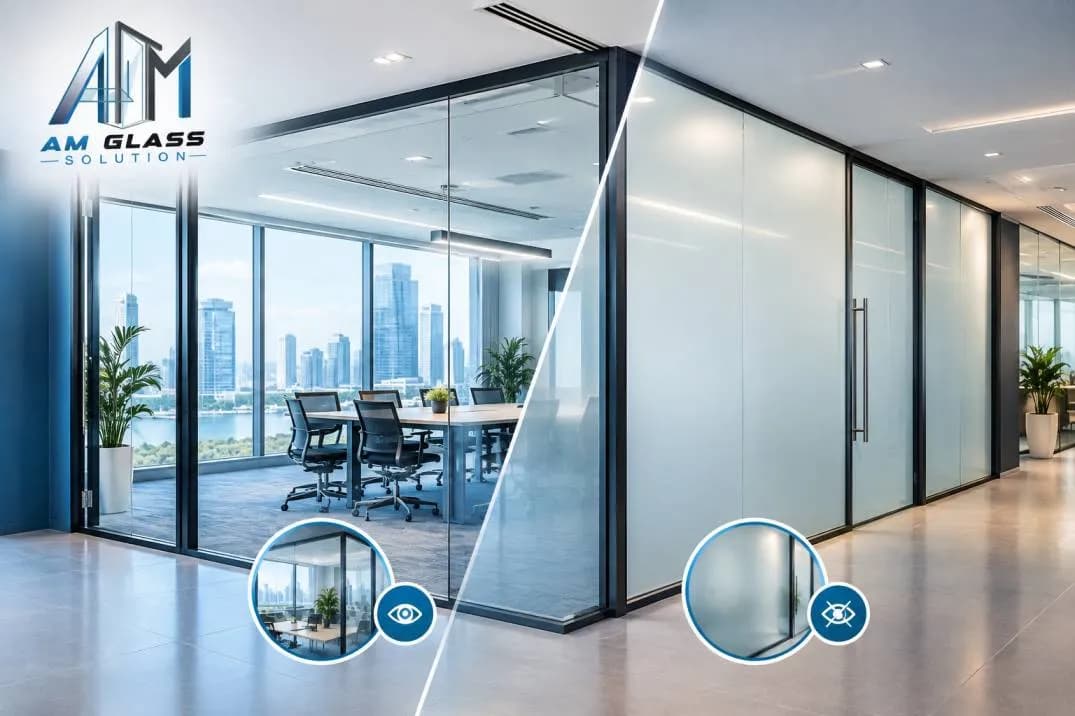
In its private state, the PDLC layer scatters light and the glass appears frosted. When powered, the liquid crystals align and the glass becomes substantially clearer.
This creates two practical modes:
Clear → open office visibility
Private → confidential meeting/privacy
The exact visual performance depends on the selected product and installation specification, so the product should be assessed rather than assuming every smart film performs identically.
Smart Film vs Other Office Privacy Solutions
Privacy Solution | Existing Glass Retained? | Switchable Privacy? | Best Use |
PDLC Smart Film | Usually yes, if suitable | Yes | Existing meeting rooms and partitions |
Frosted Film | Yes | No | Permanent privacy |
Blinds | Yes | Yes, manually/automatically | Adjustable light and privacy |
Curtains | Yes | Yes | Larger spaces where soft furnishings are acceptable |
Smart Glass | Usually requires glass replacement | Yes | New glazing or glass replacement |
Permanent Frosted Glass | Usually requires replacement | No | Fixed privacy requirement |
For an office that already has good-quality glass and does not need to replace it, smart film can be particularly attractive because the objective is to upgrade the privacy function rather than unnecessarily replace the glazing. Singapore suppliers similarly distinguish retrofit smart film from integrated smart glass used for new or replacement glazing.
Why Smart Film Can Make Sense for Singapore Offices
1. You Can Keep the Existing Glass
If the existing glass is suitable, smart film can potentially add switchable privacy without removing the entire glass panel.
This can be especially useful in an occupied office where unnecessary demolition and glass replacement would create disruption.
2. Privacy Is Available Only When Needed
A meeting room does not necessarily need to be private all day.
Keep the room visually connected to the office during normal use and switch it to private mode for confidential conversations.
3. The Office Can Keep Its Open Feel
Permanent frosting blocks the view continuously.
Smart film allows the office to retain the visual openness of glass when transparency is useful.
4. No Conventional Curtain Track
For modern office interiors, adding curtains or bulky blinds can change the appearance of an otherwise clean glass partition.
Smart film keeps the privacy mechanism integrated with the glass surface.
5. It Can Be Retrofitted
This is one of the main reasons smart film is relevant to existing offices.
Rather than treating the entire glass partition as something that needs replacing, the existing installation can first be assessed for retrofit suitability.
When Smart Film May NOT Be the Best Choice
Smart film should not be recommended automatically.
If the existing glass is damaged, unsuitable for the intended application or already due for replacement, installing film may not be the most sensible approach.
In that situation, integrated smart glass may be worth considering.
Smart glass incorporates the switchable technology into the glass construction itself and is generally more appropriate when new glazing or replacement glazing is already part of the project.
Likewise, if the office only needs permanent privacy and never needs the glass to become transparent, conventional frosted film or another fixed privacy treatment may be more appropriate.
This is why the right approach should start with the existing glass and the actual privacy requirement, not with a predetermined product.
How to Decide What Your Office Needs
Before choosing a privacy solution, answer five questions.
1. Do you need privacy all the time?
If yes, permanent frosting may be sufficient.
If privacy changes throughout the day, switchable technology becomes more relevant.
2. Do you want to keep the existing glass?
If yes, investigate whether the existing panel is suitable for retrofit smart film.
3. Is the glass already being replaced?
If yes, compare integrated smart glass with other new-glazing options.
4. Is the room exposed to moisture or demanding conditions?
The installation environment matters. Glass condition, moisture, heat, edge exposure, cleaning requirements and electrical access can all affect product selection.
5. How will the privacy system be controlled?
Depending on the selected system, control may involve a wall switch, remote control or compatible automation system. The electrical route and controller location should be considered before installation.
How Smart Film Is Installed on Existing Office Glass
A professional retrofit should not begin with simply sticking film onto the glass.
A practical process is:
Step 1 — Inspect the existing glass
Check its condition, dimensions, edges, access and intended use.
Step 2 — Understand the privacy requirement
Identify which rooms require privacy and when.
Step 3 — Determine film suitability
Assess whether the existing glazing is appropriate for the selected smart film.
Step 4 — Plan electrical routing
Determine where power, switches and controllers will be positioned.
Step 5 — Prepare the glass
The glass surface needs appropriate preparation before application.
Step 6 — Apply and finish the film
Accurate measurement, alignment, application and edge finishing are important to the final appearance.
Step 7 — Test the system
Check switching, control operation, visual appearance and electrical connections before handover.
The quality of the installation therefore matters just as much as selecting the technology.
Common Mistakes When Adding Privacy to Existing Office Glass
Choosing the cheapest film without checking specifications
“Smart film” describes a technology, not one identical product. Clarity, haze, electrical requirements, warranty and installation details can vary.
Assuming every glass panel can be retrofitted
Existing glass should be assessed before committing to the solution.
Forgetting the electrical installation
Smart film requires electrical power and appropriate control planning.
Treating smart film as blackout glass
PDLC privacy technology creates visual privacy, but private/frosted mode should not automatically be interpreted as complete blackout.
Ignoring the edges
Electrical connections and film edges need careful detailing because they are part of the finished installation.
What Should You Ask Before Hiring a Smart Film Installer?
Before approving a quotation, ask:
Is my existing glass suitable for smart film?
What type of PDLC film is being proposed?
What will the glass look like in private mode?
What happens if electrical power is interrupted?
Where will the wiring and controller be installed?
How will the film edges be finished?
What warranty is provided?
Is the proposed system suitable for my office environment?
What maintenance is required?
Would replacing the glass with integrated smart glass be more appropriate?
A professional recommendation should explain why a particular solution suits your existing glass, rather than simply presenting smart film as the answer to every privacy problem.
The Practical Choice for Existing Singapore Offices
For an existing office with good-condition glass that needs privacy on demand, retrofit PDLC smart film deserves serious consideration.
It can provide the functionality many offices actually need:
Keep the glass transparent when collaboration and openness matter.
Switch it to private when confidentiality matters.
But the correct solution depends on the existing glazing and the intended application.
If the glass is suitable and replacement is unnecessary, smart film can be a practical retrofit route. If the glass already needs replacement, integrated smart glass may make more sense. If permanent privacy is all that is required, conventional frosting may be sufficient.
That decision should be made after assessing the actual site—not simply based on the product name.
Looking for Smart Privacy for Existing Office Glass in Singapore?
AM Glass Solution Services provides smart switchable glass solutions for applications where privacy and glass design need to work together.
Instead of assuming that every office requires the same solution, the starting point should be the existing glass, the required privacy level and the intended use of the room.
For an existing office meeting room, glass partition or other suitable glass installation, you can explore the smart switchable glass service here:
Smart Switchable Glass Singapore:
https://amglasssolution.com/services/smart-switchable-glass
Recommended customer journey:
Existing glass → Site/application assessment → Suitable privacy solution → Installation → Testing → Practical handover
Frequently Asked Questions
What is the best privacy solution for existing office glass?
For suitable existing glass where privacy needs to switch between clear and private, retrofit PDLC smart film is a strong option to assess. If the glass needs replacement, integrated smart glass may be more appropriate.
Can smart film be installed without replacing existing office glass?
Yes, self-adhesive PDLC smart film is specifically designed as a retrofit solution for suitable existing glass. The glass should be assessed before installation.
Is smart film better than frosted film?
It depends on the requirement. Frosted film provides permanent privacy, while smart film provides switchable privacy. If a meeting room needs to alternate between open visibility and confidentiality, switchable film provides functionality that permanent frosting does not.
Smart film or smart glass—which is better for an existing office?
If suitable existing glass can remain in place, smart film is the retrofit option to investigate. If the glass is already being replaced, integrated smart glass may be worth comparing.
Can smart film be used on office meeting-room partitions?
Yes. Existing glass meeting rooms and office partitions are among the applications currently promoted for retrofit smart film in Singapore.
Does smart film require electricity?
Yes. PDLC smart film requires electrical power to change to its clearer state. The specific electrical requirements depend on the selected system.